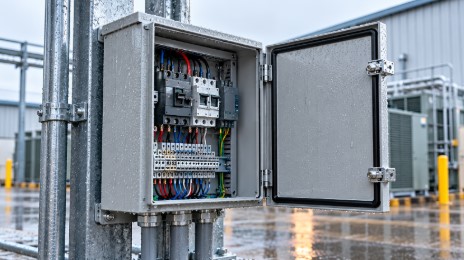
Electrical equipment installed outside faces conditions that an ordinary indoor cabinet may not address. However, outdoor exposure does not describe one uniform environment. Choosing an outdoor NEMA 3R enclosure begins with identifying rain, dust, washing, corrosion, and other site conditions separately before deciding whether the rating matches the application.
Understand What Type 3R Covers
Type 3R addresses a degree of protection against access to hazardous parts, falling dirt, and harmful ingress associated with rain, sleet, and snow. It also addresses the enclosure remaining undamaged by external ice formation.
Those statements have limits. They do not mean every enclosure remains completely dry under every weather condition or that external mechanisms must remain operable when ice forms.
An outdoor NEMA 3R enclosure should therefore be selected from its documented rating and installation instructions, not from a general description such as weatherproof.
Know What Is Not Included
Type 3R does not include the windblown-dust protection associated with Type 3. It also does not establish protection against hose-directed water, submersion, or the additional corrosion resistance associated with an X designation.
That distinction matters near washdown areas, dusty processes, coastal exposure, or chemical operations. A cabinet suitable for ordinary precipitation may be inappropriate beside equipment regularly cleaned with a hose.
Before specifying an outdoor NEMA 3R enclosure, list the actual exposures rather than assuming that all outdoor hazards are covered together.
Assess the Site Carefully
Useful questions include:
- Will rain strike the installation directly?
- Is windblown dust a significant concern?
- Could cleaning water reach the cabinet?
- Are salt, chemicals, or corrosive atmospheres present?
- Can water collect around its mounting location?
- What temperature and solar exposure will occur?
The answers help distinguish environmental protection from other engineering requirements. The enclosure rating alone does not establish acceptable internal operating temperature or suitability for a hazardous classified location.
Follow the Intended Installation Arrangement
Mounting orientation, door position, cable entry, and drainage details affect the enclosure’s performance. An approved design should be installed as instructed rather than modified for convenience without review.
Some Type 3R designs manage limited water entry through drainage provisions. Blocking or sealing those features indiscriminately can interfere with the intended protection method.
For an outdoor NEMA 3R enclosure, ask the manufacturer how mounting and field entries should be arranged. Do not assume every construction uses the same sealing or drainage approach.
Review Cable Entries and Accessories
The enclosure body is only one part of the completed installation. Conduit fittings, cable glands, hubs, operators, and other accessories must suit the application and installation details.
A new opening can create a path for water or contamination. Check the accessory’s rating, permitted location, and fixing instructions before drilling or cutting.
An outdoor NEMA 3R enclosure should not be assumed to retain its original performance after arbitrary modifications. Obtain manufacturer guidance and any required evaluation of the completed assembly.
Plan for Internal Heat
Equipment inside a cabinet can generate heat, while direct sunlight can increase thermal loading. Selecting a suitable environmental rating does not complete the thermal design.
Review component heat losses, allowable operating temperatures, ambient conditions, and available cooling options. Any ventilation or cooling accessory must be compatible with the intended enclosure protection.
Avoid adding an unreviewed fan opening simply because the cabinet feels warm. Thermal management and environmental integrity need to be designed together.
Confirm Documentation and Approval
Ask for drawings, the exact enclosure designation, material information, and any applicable third-party certification details. A claimed type designation and a particular product listing are not identical statements.
Confirm whether approval applies to the empty enclosure, a modified cabinet, or the completed control assembly. Responsibilities can differ between the enclosure supplier, panel builder, installer, and owner.
Document the agreed arrangement for the outdoor NEMA 3R enclosure before fabrication or installation begins.
Maintain the Installed System
Inspect doors, latches, coatings, fittings, and drainage features at intervals appropriate to the location. Look for damage, loose accessories, corrosion, or changes to the surrounding exposure.
Work involving electrical equipment should be performed by qualified personnel using appropriate isolation and safety procedures. An enclosure is not a substitute for safe electrical maintenance.
Conclusion
A suitable selection starts with the actual environment and continues through mounting, accessories, thermal planning, and documentation. Applications involving hose-directed water or additional corrosion concerns may require evaluation of NEMA 4X enclosures rather than assuming Type 3R is sufficient. Match the documented protection to the site before choosing the cabinet.