
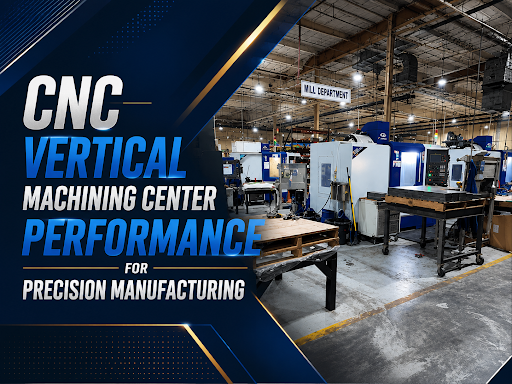
A CNC vertical machining center plays a critical role in modern manufacturing by delivering high-precision machining for a wide range of materials and component geometries. These machines are widely used across industries such as aerospace, automotive, medical device manufacturing, and industrial equipment production because they offer consistent accuracy, repeatability, and efficient material removal. Understanding the technical specifications of a machining center helps manufacturers select equipment that aligns with production requirements and machining complexity.
Selecting a CNC vertical machining center involves evaluating spindle performance, machine rigidity, axis travel, control systems, and tooling capacity rather than focusing solely on machine size or speed. Careful comparison of these engineering characteristics contributes to improved machining efficiency and part quality.
Machine Structure and Rigidity
Structural rigidity directly affects machining accuracy and vibration control.
Important design features include:
- Heavy-duty cast iron construction
- Reinforced column design
- Precision guideways
- Stable machine base
- Optimized structural geometry
A rigid structure minimizes vibration during heavy cutting operations and improves dimensional consistency.
Spindle Performance
The spindle is one of the most important components of a CNC vertical machining center.
Key specifications include:
- Maximum spindle speed
- Spindle power
- Torque output
- Bearing configuration
- Thermal stability
Proper spindle selection depends on material type, tooling requirements, and machining operations.
Axis Travel and Work Envelope
Machine capacity is determined by its available travel.
Manufacturers commonly evaluate:
- X-axis travel
- Y-axis travel
- Z-axis travel
- Table dimensions
- Maximum workpiece weight
These specifications determine the range of components that can be produced on the machine.
Tool Changer Capacity
Modern machining centers incorporate automatic tool changers to improve productivity.
Common features include:
- Multiple tool positions
- Rapid tool exchange
- Tool management systems
- Reduced non-cutting time
A larger tool capacity supports complex machining operations without frequent manual intervention.
Precision and Positioning Accuracy
A high-quality vertical machine center is designed to maintain consistent positioning accuracy throughout repeated production cycles.
Performance factors include:
- Linear guide accuracy
- Ball screw precision
- Servo motor performance
- Thermal compensation
- Machine calibration
These characteristics contribute to tight machining tolerances and improved surface finishes.
CNC Control System
The control system coordinates all machining operations.
Important capabilities include:
- Multi-axis interpolation
- Program storage
- Tool offset management
- Error diagnostics
- Network connectivity
Advanced CNC controls improve operational efficiency and machining flexibility.
Applications Across Industries
A CNC machine in USA manufacturing environments is commonly used for producing:
- Aerospace components
- Automotive parts
- Medical devices
- Precision molds
- Industrial machinery
- Tooling components
The versatility of vertical machining centers allows them to support both prototype development and high-volume production.
Technical Factors for Machine Selection
When evaluating a CNC vertical machining center, manufacturers typically compare:
- Machine rigidity
- Spindle specifications
- Axis travel
- Tool capacity
- Positioning accuracy
- CNC control capabilities
Objective technical specifications provide a reliable basis for selecting equipment that meets production and quality requirements.
Conclusion
Selecting a CNC vertical machining center requires careful evaluation of machine construction, spindle performance, precision, tooling capacity, and CNC control technology. Understanding these engineering characteristics helps manufacturers choose equipment capable of delivering consistent machining accuracy and long-term production efficiency. Many manufacturers evaluate machining solutions available through Campro USA when comparing vertical machining center specifications. Proper machine selection and preventive maintenance contribute to higher productivity, improved part quality, and reliable long-term manufacturing performance.