
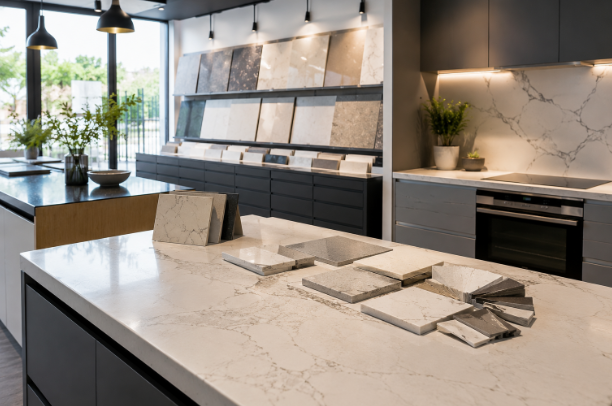
Choosing a kitchen worktop involves balancing appearance, durability, maintenance, and the practical requirements of everyday use. Online images can provide an initial idea of colour and pattern, but seeing physical samples can make it easier to understand how a surface will look under different lighting conditions. Visiting a Quartz showroom allows homeowners and designers to compare colours, finishes, textures, and patterns in person before making a decision. It can also provide an opportunity to assess different materials and understand which characteristics are most suitable for a particular kitchen or bathroom.
Why Visit a Quartz Showroom?
A worktop can look noticeably different in a photograph compared with how it appears in natural or artificial light. Digital screens can also alter colours, making it difficult to judge subtle differences between whites, greys, creams, and other neutral tones.
A Quartz showroom allows customers to examine physical samples and compare them directly. This can be especially useful for quartz surfaces with veining or complex patterns because the scale and movement of the design may not be obvious from a small online image.
Quartz Supply offers a broad selection of quartz colours and patterns from several ranges, including Silestone, Unistone, Cimstone, Classic Range, Nile Range, and Artemis Stone.
What Should You Look for in a Quartz Worktop?
When comparing quartz worktops, appearance is only one consideration. A suitable surface should also meet the practical requirements of the room.
Important characteristics to consider include:
- Resistance to everyday scratches
- Resistance to staining
- Water absorption
- Heat tolerance
- Cleaning requirements
- Surface finish
- Colour consistency
- Edge and fabrication options
- Thickness and dimensions
- Compatibility with sinks and appliances
Quartz showroom is an engineered material, so the exact composition and performance characteristics can vary between products. Checking the manufacturer’s specifications is therefore important rather than assuming every quartz surface will perform identically.
Understanding Quartz’s Non-Porous Surface
One of the commonly discussed characteristics of engineered quartz is its low porosity. A non-porous surface does not readily absorb liquids, which can make it useful in kitchens where water, cooking oils, sauces, coffee, and other substances frequently come into contact with the worktop.
Quartz Supply describes quartz worktops as non-porous and resistant to common stains, making them suitable for food preparation and other areas exposed to moisture.
However, low porosity does not eliminate the need for cleaning. Spills should still be removed promptly, and manufacturers’ care instructions should be followed to protect the finish.
Comparing Colours and Patterns
Colour selection can have a major effect on the overall appearance of a kitchen. White and pale quartz surfaces can help create a bright, open feeling, while darker surfaces can add contrast against light cabinetry.
Veined quartz can provide a more decorative appearance inspired by natural marble. Subtle veining may work well in minimalist kitchens, whereas stronger patterns can create a focal point around an island.
Neutral colours can also offer greater flexibility if homeowners later change cabinet colours, flooring, handles, or wall finishes.
When viewing samples, compare them against the actual kitchen materials wherever possible. A quartz surface that looks suitable in isolation may appear different when placed beside a particular cabinet or flooring colour.
Polished and Suede Finishes
The surface finish can influence both the appearance and feel of a quartz worktop. Polished finishes generally provide a smoother, reflective appearance that can help bounce light around a room.
Suede or honed-style finishes tend to create a more muted appearance with less reflection. Quartz Supply’s Blanco Orion product information notes that polished finishes can brighten open-plan spaces, while suede options offer a more understated architectural appearance.
The best finish depends on the desired visual effect, lighting conditions, and manufacturer’s maintenance recommendations.
Choosing Quartz for a Busy Kitchen
A busy kitchen places greater demands on its worktop. Food preparation, cooking, cleaning, and frequent contact with cookware can all contribute to everyday wear.
Quartz can be a practical option because engineered surfaces are designed to resist many common forms of wear. Quartz Supply describes its worktops as impact-resistant and scratch-resistant, while also highlighting their resistance to stains and chemicals.
Nevertheless, sensible use remains important. Chopping directly on the worktop is not recommended, and trivets should be used beneath very hot cookware. These simple habits can help protect the surface from unnecessary damage.
Considering Blanco Orion Quartz
For homeowners looking for a neutral engineered surface, an option characterised by subtle grey shifts and an understated appearance. The design is intended to blend into interiors rather than dominate them, making it suitable for kitchens that combine neutral colours or feature stronger cabinetry.
Its restrained appearance can work particularly well in contemporary kitchens where the worktop needs to complement rather than compete with other design elements. It can also be paired with either bold cabinetry or softer neutral finishes.
Viewing the material in person is still useful because the perceived balance between grey tones and surrounding colours can change according to lighting.
Cleaning and Maintenance
Quartz is generally considered a relatively low-maintenance worktop material. Routine cleaning can usually involve mild soap and water, although specific cleaning instructions should always be checked for the selected product.
Abrasive cleaning pads and unsuitable chemicals should be avoided unless explicitly approved by the manufacturer. Regular cleaning helps preserve the surface’s appearance and prevents residues from accumulating.
Using chopping boards and heat-resistant mats can also reduce unnecessary wear. While quartz is durable, no worktop should be treated as completely indestructible.
Measuring and Fabricating the Worktop
Selecting a worktop is only one part of the process. Accurate measurement and fabrication are equally important because stone worktops need to accommodate the exact kitchen layout.
Measurements may need to account for:
- Sink cut-outs
- Hob openings
- Tap holes
- Wall irregularities
- Overhangs
- Joins
- Appliance positions
- Edge profiles
Quartz Supply describes a process involving an actual-size template before fabrication and installation.
Accurate templating helps ensure that the finished worktop corresponds correctly with the cabinetry and appliances.
Why Physical Samples Matter
Samples are particularly valuable when choosing between similar colours. Two white quartz surfaces can have noticeably different undertones, while grey surfaces may range from warm to cool shades.
Veined materials also benefit from physical inspection because the pattern can vary in scale and intensity. If a large island is planned, viewing a larger section of the slab can provide a more realistic impression than a small sample.
Lighting should also be considered. Compare samples in both natural daylight and the artificial lighting used in the kitchen whenever possible.
Conclusion
Choosing a quartz worktop requires consideration of appearance, durability, maintenance, surface finish, and the practical demands of the kitchen. Visiting a showroom and viewing physical samples can make it easier to compare colours and patterns while understanding how different finishes interact with surrounding materials.
For homeowners considering a Blanco Orion quartz worktop, its subtle grey tones and restrained design can provide a versatile option for contemporary and neutral kitchen interiors. Ultimately, comparing physical samples alongside cabinetry, flooring, lighting, and other finishes can help ensure the selected worktop is appropriate both visually and practically.