
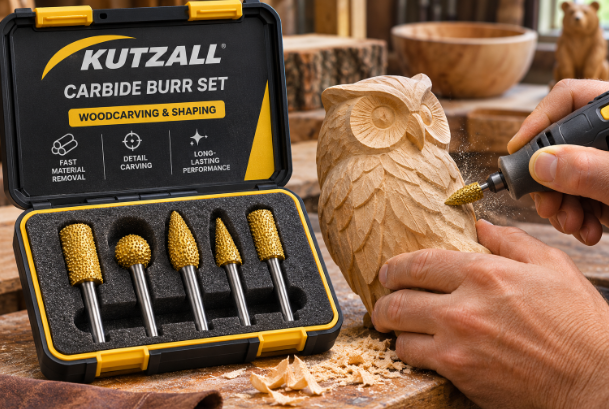
Power carving turns rough timber into smooth, detailed forms, but the results depend heavily on the cutters attached to the rotary tool.
A well-chosen carbide burr set gives woodworkers several cutting behaviours in a single box, which is useful for both beginners and experienced carvers. A kit lets you test different shapes and grits on real projects. This guide explains how shaft size, grit, and shape affect the work so you can match a kit to your needs.
What Carbide Burrs Actually Do
Carbide burrs are cutting tools covered in tungsten carbide teeth or particles. When they spin in a rotary tool, they remove wood quickly while staying sharp far longer than ordinary steel bits. They suit shaping, sanding, and fine detail work in many woods.
A typical carbide burr set combines several shapes, such as cylinders, balls, flames, and cones. Each shape reaches a different surface: cylinders flatten, balls hollow out, and pointed cones refine tight corners. Choosing a kit with a mix of shapes means fewer tool changes and more consistent progress on a carving.
Shaft Size Comes First
Before looking at shapes or grits, check the shaft diameter your tool accepts. The two common sizes are 1/8 inch and 1/4 inch. Many compact rotary tools and detail grinders take the smaller shaft, while larger die grinders and routers accept the bigger one.
The smaller shaft usually pairs with finer heads for intricate work such as faces, lettering, and small ornaments. The larger shaft handles heavier stock removal and tolerates more torque. Kits are usually grouped by shaft size, and they often contain three to five pieces, so confirm that your collet matches before ordering.
Understanding Grit Levels
Burrs are commonly graded as fine, coarse, or very coarse, with variety kits mixing several grades. The grade controls how much wood each pass removes and how smooth the surface feels afterward.
Fine Grit
A fine carbide burr set removes small amounts of material and leaves a surface that needs little sanding. They suit detail work, final shaping, and soft or delicate woods.
Coarse and Very Coarse Grit
A coarse or very coarse carbide burr set excels at fast stock removal. They are helpful when roughing out a bowl, spoon, or sculpture from a blank. The trade-off is a rougher surface, so most carvers follow them with a finer grade.
Variety Kits
A variety option blends grades and shapes. For a new carver, a carbide burr set of this type is often the most practical starting point because it reveals which combination feels natural before committing to larger purchases.
Matching the Kit to the Project
Consider what you carve most often. A person making small figurines benefits from a fine detail carbide burr set with 1/8 inch shafts. Someone shaping furniture parts or large bowls will likely prefer a coarse kit with 1/4 inch shafts for faster removal.
Wood type matters too. Dense species such as maple or oak create more heat and resistance, so moderate speed works better than forcing the tool. Softer species like basswood respond well to finer grades, which help prevent tear-out.
Keep a few practical points in mind:
- Start at lower tool speeds and increase gradually.
- Let the burr do the cutting rather than pressing hard.
- Move the tool continuously to avoid burn marks.
- Test on scrap wood before working on the final piece.
Care, Safety, and Storage
Carbide is hard but brittle, so avoid dropping burrs or letting them knock against each other in a drawer. Store them in the case they came in. Clean resin and dust with a stiff brush, since clogged teeth cut poorly and generate extra heat.
Always wear eye protection, a dust mask, and hearing protection when power carving. Secure the workpiece with clamps so both hands stay on the tool. Replace any burr with chipped or missing teeth, because damaged cutters can grab unexpectedly.
Conclusion
Choosing the right carbide burr set comes down to three decisions: shaft size, grit level, and the shapes that suit your projects. Power burrs remove waste quickly, and many carvers then switch to a hand-stitched rasp for gentle curves and a different surface texture. Sensible speeds, solid clamping, and regular cleaning keep every cutter predictable. Careful practice on scrap wood will build confidence before you start your next piece.