
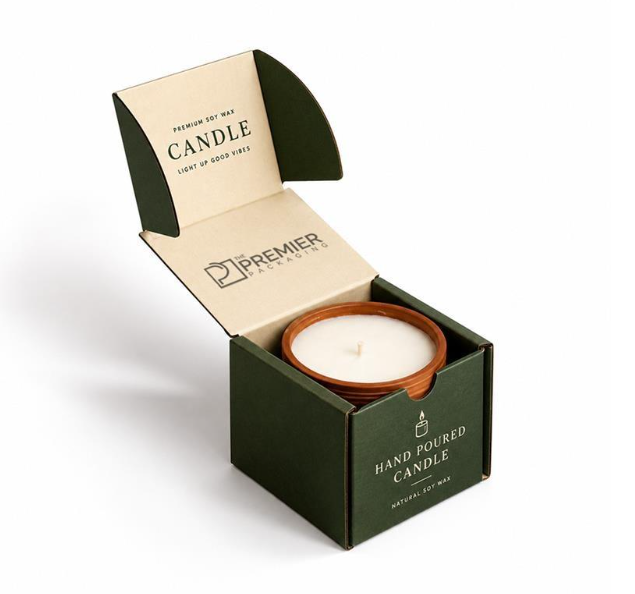
The usual reason candle boxes get sized wrong is that people mistakenly expect that this happens all the time and that the size they’re using is inaccurate. That’s typically because nothing scales like diameter and height. The box that fits the first dimension perfectly may be completely wrong for the other. Two candles, one tall and narrow, the other short and wide, may have similar weight and cost, but will require almost different dimensions to fit the box and give a proper appearance on the shelf.
Diameter Affects Stability More Than People Realize
A candle’s diameter isn’t just about how much interior width the box needs – it directly affects how stable the candle is once it’s sitting inside packaging. Wider candles have a lower center of gravity relative to their base, which makes them naturally more resistant to tipping or shifting during shipping. Narrow candles, especially taller ones, are far more prone to leaning or toppling if the box gives them even a small amount of extra room to move.
This is why box width needs to track closely with actual candle diameter rather than being rounded up “just in case.” A little extra room might seem harmless, but for narrower candles, that gap is often exactly what allows tipping and surface scuffing to happen during transit.
Height Determines a Different Set of Risks
Where diameter mostly affects stability, height changes the pressure dynamics at play. Taller candles carry more weight higher up, which means they’re more vulnerable to toppling under vibration and more likely to transfer stress downward onto their base if the box gets compressed from above. A box that’s too short for the candle’s height forces an awkward fit that can crack a container or deform the wax at the top edge. Too tall, and the extra vertical space becomes wasted room where the candle can shift or where stacked boxes above it can crush inward without resistance.
Getting height right also affects how many candles can realistically stack per pallet or shipping container, which matters more at scale than most smaller brands initially account for.
How Diameter and Height Interact
Neither dimension works in isolation, and the relationship between the two often decides what kind of internal support a box actually needs.
| Candle Profile | Primary Risk | Box Priority | Typical Support Needed |
| Short and wide | Minimal – naturally stable | Snug diameter fit | Light cushioning, minimal insert |
| Tall and narrow | High – prone to tipping | Tight diameter, reinforced base | Fitted insert or base stabilizer |
| Tall and wide | Moderate – weight concentration | Sturdy vertical structure | Reinforced walls, base support |
| Short and narrow | Low-moderate | Compact fit | Simple foam or cardboard insert |
Tall, narrow candles almost always need the most attention here, since they combine the instability of a small base with the added leverage of extra height. A wide, short candle rarely needs much beyond a snug fit in diameter, since its own shape does most of the stabilizing work.
Why Rounding Up Just in Case Backfires
A common mistake among smaller candle brands is ordering boxes slightly larger than needed, assuming extra room provides a safety buffer. In practice, that extra space usually works against the candle rather than for it. Loose interior space allows movement, and movement is what actually causes most shipping damage – scuffed surfaces, cracked containers, wicks pulled off-center. A snug-fitting box, even without elaborate internal padding, often protects better than a larger box with generic filler material tossed in to fill the extra space.
Ordering at Scale Changes the Calculation
Brands producing candles at volume have more reason than ever to get sizing precise, since even small dimensional inefficiencies compound significantly across a large production run. Working with wholesale candle packaging supplies rather than ordering smaller custom batches one at a time often gives growing brands better access to precisely sized boxes across a full range of candle dimensions, without paying a premium for each individual size adjustment.
This matters especially for brands producing multiple candle sizes within a single product line, since a wholesale relationship typically makes it more practical to maintain several precisely fitted box sizes rather than settling for a single generic size that fits nothing particularly well.
Testing Real Product Before Committing to Box Specs
Spec sheets and measurements provide a starting point, but they don’t always account for slight manufacturing variation between individual candles, particularly with hand-poured or small-batch production. Testing actual finished candles in a sample box, rather than relying solely on theoretical dimensions, tends to catch fit issues before they lead to a full production run of boxes slightly off in one direction or the other.
Final Words
Getting candle box sizing right isn’t really about picking a box that technically fits – it’s about understanding how diameter and height interact to create very different stability and protection needs depending on the candle’s actual shape. A box built specifically around those two measurements, rather than rounded up for convenience, tends to protect the product better and waste less material in the process. For candle brands scaling production, that kind of precision in sizing pays off more than most people expect once it’s applied across a full catalog rather than just one product.