
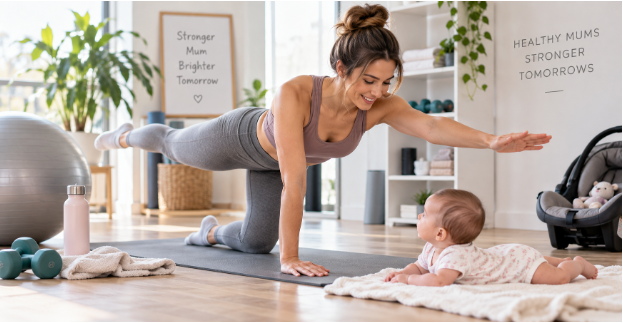
Pregnancy and childbirth can bring substantial changes to strength, mobility, posture, breathing patterns, and everyday movement. Returning to exercise is therefore not simply about resuming a previous workout routine. The body may need time to rebuild capacity, particularly around the abdominal and pelvic floor muscles. A well-structured postpartum exercise program should account for recovery, current fitness, symptoms, daily demands, and individual goals rather than applying the same progression to everyone. Healthdirect also recommends seeking advice from a doctor or exercise professional before starting a new exercise program, particularly when health conditions or other physical limitations are involved.
Begin With Recovery, Not Intensity
The early postnatal period is primarily about recovery and restoring comfortable movement. Walking, gentle mobility, breathing exercises, and appropriately guided pelvic floor work may form part of this stage. Pelvic floor exercises can be performed after childbirth, although individual circumstances should be considered and guidance from a doctor or midwife may be appropriate.
Rather than judging progress by how quickly someone returns to previous weights or running distances, early goals can include moving comfortably, coordinating breathing with movement, and managing ordinary activities such as lifting, carrying, and getting up from a chair.
Progress Through Manageable Stages
A phased approach makes it easier to increase physical demands gradually. The supplied program describes three broad stages: an initial period focused on pelvic floor, deep-core activation, breathing, mobility, and daily function; a subsequent stage introducing whole-body strength and low-impact cardiovascular activity; and a later stage progressing toward higher-intensity training, running, or sport.
This type of progression recognizes that recovery does not occur at the same speed for everyone. Sleep, energy levels, birth experience, breastfeeding, previous fitness, and symptoms can all affect how much activity is appropriate at a particular point.
Rebuild Core and Pelvic Floor Control
Core rehabilitation after pregnancy should involve more than immediately returning to traditional abdominal exercises. Breathing mechanics and coordination between the diaphragm, deep abdominal muscles, and pelvic floor can provide a foundation for later strengthening.
A postpartum exercise program may therefore begin with controlled movements before progressing toward exercises such as bridges, squats, light resistance work, and other functional patterns. The emphasis should remain on movement quality and control rather than simply completing more repetitions.
Pelvic floor exercises can also form part of recovery. Healthdirect notes that pelvic floor muscles support the bladder, uterus, and bowel and can be strengthened during pregnancy and after childbirth.
Introduce Strength in Practical Ways
Strength training can help rebuild the physical capacity required for everyday postnatal activities. Exercises can be selected around movements that commonly occur while caring for a baby, including lifting, carrying, squatting, pushing, and reaching.
Resistance does not necessarily mean heavy weights. Bodyweight movements, resistance bands, and light weights can provide starting points before load or complexity is increased. Healthdirect recommends gradually building strength and using appropriate technique rather than progressing too quickly.
Add Cardiovascular Work Gradually
Walking, cycling, and swimming can provide lower-impact ways to rebuild cardiovascular capacity when appropriate. The duration and intensity can increase progressively as recovery allows.
Shorter periods of activity can also be useful when caring for a newborn makes longer sessions difficult. Healthdirect notes that physical activity can be divided into shorter periods throughout the day rather than completed in one continuous session.
Conclusion
Returning to exercise after childbirth works best as a gradual process built around recovery, movement quality, and changing physical capacity. A structured postpartum exercise program can progress from gentle mobility and pelvic floor work toward strength, cardiovascular conditioning, and eventually more demanding activities when appropriate. Professional assessment can help determine which movements and progression levels are suitable for an individual’s circumstances. For those seeking guidance locally, physio in Leichhardt may be relevant when recovery requires physiotherapy input, particularly for pelvic floor concerns, birth-related issues, or movement limitations. The central principle remains consistent: build capacity progressively, monitor how the body responds, and adapt exercise to the person’s recovery rather than following an inflexible timeline.