
Shrink packaging problems often show up after a product leaves the tunnel: loose film, wrinkles, burned areas, uneven corners, or seals that open during shrinking. These defects can look like film problems, but they may actually come from temperature, airflow, conveyor speed, product spacing, or upstream sealing.
A heat shrink tunnel works best when these variables are balanced rather than adjusted independently. Understanding what different defects usually indicate can help packaging teams troubleshoot faster, reduce rejected packages, and maintain more consistent production.
Why Does Film Leave the Tunnel Too Loose?
Loose film generally means the material has not received enough effective heat exposure.
That does not always mean the temperature setting is too low. The conveyor may be moving too quickly, airflow may not be reaching the package evenly, or the film specification may require different operating conditions.
When troubleshooting a heat shrink tunnel, operators should check:
- Tunnel temperature
- Conveyor speed
- Film type and gauge
- Package dimensions
- Airflow
- Product orientation
Increasing temperature immediately may hide another problem and expose the product to unnecessary heat.
Small, controlled adjustments are usually easier to evaluate.
What Causes Wrinkles Around the Package?
Wrinkles can have several causes.
Too much film around the product can leave excessive material that has difficulty shrinking smoothly. Uneven airflow may also cause some areas to contract before others.
Incorrect product positioning and temperature settings can contribute as well.
A heat shrink tunnel should be tested with the actual package rather than adjusted according to temperature alone.
If wrinkles repeatedly appear in the same area, airflow or package orientation may deserve particular attention.
Changing how the product enters the tunnel can sometimes improve results without significantly altering temperature.
Why Does Shrink Film Burn or Develop Holes?
Burning usually suggests excessive heat exposure.
Possible causes include a temperature setting that is too high, conveyor speed that is too slow, or a combination of both.
Film gauge and formulation also matter. A thin film may react very differently from a heavier material under identical settings.
When a heat shrink tunnel produces holes or overheated areas, reduce one variable at a time and inspect the next packages carefully.
It is useful to keep records of successful tunnel settings for each film and product combination so operators do not have to rediscover suitable parameters during every production run.
Why Do Seals Open Inside the Tunnel?
An open seam is often an upstream sealing problem rather than a tunnel problem.
Shrink film generates tension as it contracts. If the original seam is weak, that tension can pull it apart inside the heated chamber.
Before changing the heat shrink tunnel, inspect the sealing process.
Possible causes include:
- Insufficient seal temperature
- Contaminated sealing surfaces
- Worn sealing components
- Incorrect film alignment
- Excessive film tension
- Poor product positioning
The sealer and tunnel should be treated as connected parts of one packaging system.
A perfectly configured tunnel cannot compensate for an unreliable seal.
Uneven Shrinking Often Points to Airflow
One side of a package may look smooth while another remains loose.
This frequently indicates that heat is not reaching all surfaces equally.
A tunnel relies on controlled circulation, not just high temperature. Product shape, spacing, and position on the conveyor can alter how air moves around the package.
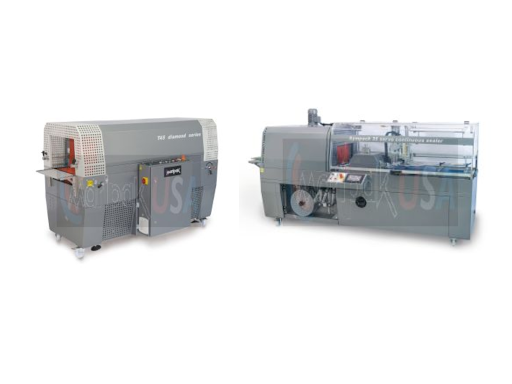
The Diamond Series tunnel design, for example, uses circulated hot air as part of the shrinking process, illustrating how airflow is central to tunnel performance.
For any heat shrink tunnel, operators should keep airflow paths clear and make sure products do not enter the chamber so closely together that they shield one another.
Conveyor Speed Can Solve More Problems Than Expected
Conveyor speed controls how long a package stays inside the heated zone.
Increasing speed reduces dwell time. Slowing the conveyor increases it.
Because dwell time and temperature work together, conveyor adjustment can often solve shrink problems without a major temperature change.
For example, if the film is almost fully shrunk but remains slightly loose, a small reduction in speed may provide enough additional exposure.
A heat shrink tunnel should therefore be tuned by considering speed and temperature as a pair.
Changing both at once, however, makes it harder to determine which adjustment actually solved the problem.
Product Spacing Affects Heat Distribution
Crowded packages can create inconsistent shrink.
When products move through a tunnel too closely together, hot air may have difficulty reaching the sides facing neighboring packages.
Consistent spacing also helps maintain predictable production flow.
The infeed conveyor should provide enough separation for the heat shrink tunnel to expose each package evenly.
For automated lines, sensors or programmed conveyor controls may assist with spacing. Semi-automatic operations can use guides or clear operator procedures.
Whatever method is used, maintaining a stable product gap improves repeatability.
Film Size Can Create Hidden Problems
Using more film than necessary may seem harmless, but it can create shrink defects.
Large amounts of excess film must contract around the product, increasing the chance of wrinkles, thick seams, or loose corners.
Using too little film can create a different problem by placing excessive tension on seals.
A properly configured heat shrink tunnel performs best when the upstream wrapping process provides an appropriate amount of film for the package.
Film width and length should therefore be reviewed whenever recurring defects appear, particularly if temperature and airflow seem correct.
Product Shape Changes Tunnel Behavior
Not every product should be processed using identical settings.
Flat cartons, tall boxes, cylindrical items, irregular shapes, and multipacks interact with hot air differently.
A tall package may create a larger vertical surface that changes airflow, while a product with gaps or openings can allow heat to circulate through unexpected areas.
Operators should test several orientations before deciding that a heat shrink tunnel needs a major configuration change.
In some cases, rotating the product on the conveyor produces a more even shrink pattern with the same tunnel settings.
Extended Tunnels Can Help With Certain Products
Some products benefit from longer heat exposure rather than higher temperatures.
Longer packages, thicker films, or applications requiring greater dwell time may perform better in an extended chamber.
Current Diamond Series configurations include extended-length versions intended for applications where additional tunnel length is useful.
The principle is important when evaluating any heat shrink tunnel: additional dwell time can sometimes produce smoother results than simply increasing heat intensity.
Equipment should therefore be matched to both product dimensions and film behavior.
Double-Chamber Designs Suit Demanding Throughput
High-volume lines may require more processing capacity.
Double-chamber configurations provide additional heated length or thermal processing capacity, which can be useful when production speeds are high.
However, larger equipment only improves throughput when upstream and downstream machines can keep pace.
If the sealer is the actual bottleneck, increasing heat shrink tunnel capacity will not automatically increase total output.
Packaging lines should be evaluated as complete systems, including feeding, sealing, shrinking, cooling, and discharge.
Cooling Problems Can Affect the Final Appearance
Shrink film remains warm immediately after the package exits the tunnel.
If products are stacked, pressed together, or handled aggressively before the film stabilizes, marks or distortion can occur even though the tunnel performed correctly.
A discharge conveyor should provide enough space for cooling.
This means troubleshooting should not stop at the exit of the heat shrink tunnel.
If defects appear only after downstream handling, the problem may be the cooling or accumulation process rather than the heat settings themselves.
Maintenance Can Prevent Gradual Quality Loss
Shrink quality can deteriorate slowly as components wear or become dirty.
Fans, heaters, sensors, conveyors, and airflow passages should be inspected according to the equipment’s maintenance schedule.
Film residue and debris may also affect performance.
If a heat shrink tunnel previously produced good packages using the same film and settings but gradually becomes inconsistent, maintenance should be investigated before operators make large process changes.
Otherwise, increasing temperature to compensate for a mechanical problem may create additional defects.
Use a Structured Troubleshooting Process
Random machine adjustments can waste time.
A better method is to change one variable at a time and document the result.
A simple troubleshooting sequence might be:
- Check film specification.
- Inspect seal quality.
- Confirm product position and spacing.
- Verify actual tunnel temperature.
- Check airflow.
- Adjust conveyor speed gradually.
- Inspect cooling and downstream handling.
- Record the final successful settings.
This approach makes a heat shrink tunnel easier to manage across different shifts and operators.
It also creates a useful history when the same product returns to production later.
Conclusion
Most shrink-packaging defects can be traced to a limited group of variables: heat, dwell time, airflow, film sizing, sealing quality, product positioning, and cooling. A heat shrink tunnel performs most consistently when these factors are reviewed together instead of relying on temperature adjustments alone. Equipment configurations available from Maripak USA include standard, extended-length, and double-chamber tunnel designs, reflecting the different heat-exposure and throughput requirements packaging operations may encounter. A structured troubleshooting process can reduce rejected packages and unnecessary downtime. By documenting successful settings and investigating the real cause of defects, packaging teams can achieve more predictable shrink quality across changing products and production runs.