
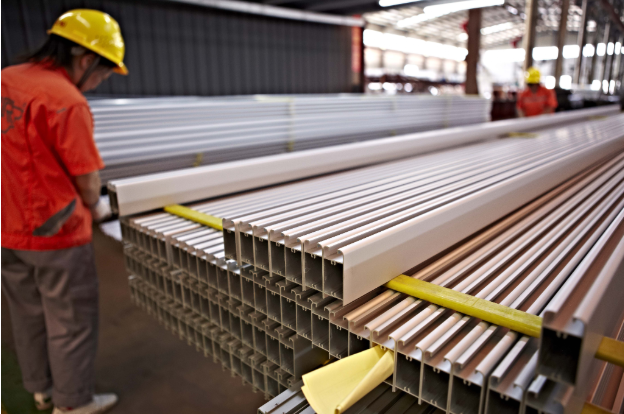
Aluminium extrusion enables manufacturers to produce precise sections for architectural, industrial, and engineering applications. Its strength-to-weight ratio, corrosion resistance, and ability to form complex cross-sections make it suitable for projects where dimensional accuracy matters. For modular construction, Aluminium modular sections can provide a practical framework for creating repeatable assemblies with consistent dimensions and dependable performance.
Facade applications place additional demands on profile geometry, surface quality, and long-term resistance to environmental exposure. The right extrusion design can support structural requirements while contributing to the appearance of a finished building. Profile selection therefore needs to account for load requirements, dimensions, finishing specifications, fabrication processes, and installation conditions.
Role of Aluminium Extrusion in Modern Construction
Extrusion converts an aluminium billet into a predetermined cross-sectional shape by forcing the heated material through a die. This process allows manufacturers to produce profiles with detailed geometries while maintaining dimensional consistency across production runs. The resulting sections can then be cut, machined, and surface treated according to project specifications.
Construction applications can include window and door systems, curtain wall structures, architectural frameworks, and facade components. Aluminium offers useful characteristics for these applications because it combines relatively low weight with mechanical strength and corrosion resistance. Its formability also allows designers to develop profiles around specific assembly and performance requirements.
Designing Sections for Modular Applications
Modular systems depend on repeatability. Components need to maintain consistent dimensions so that individual parts can be assembled, replaced, or integrated without extensive modification. Extrusion is well suited to this requirement because a single die can produce a standardized cross-section across substantial production quantities.
Profile geometry also influences how components connect and perform. Wall thickness, cavities, mounting points, grooves, and joining surfaces can be incorporated into the section during die design. This can reduce the need for unnecessary secondary fabrication while supporting efficient assembly.
- Dimensional consistency: Repeatable extrusion geometry supports predictable component integration.
- Structural efficiency: Hollow or engineered sections can provide strength without excessive material use.
- Assembly compatibility: Defined interfaces can simplify connections between modular components.
- Fabrication flexibility: Profiles can undergo cutting, drilling, milling, punching, or bending after extrusion.
Key Considerations for Facade Profile Selection
Facade profiles must satisfy both functional and architectural requirements. External building elements can experience sunlight, rain, humidity, temperature changes, and airborne contaminants over long service periods. Material selection and surface treatment therefore influence how the profile performs after installation.
Geometry is equally important because facade systems can contain multiple interfaces between frames, panels, glazing, and supporting elements. Accurate profiles help maintain alignment across these connections. The required section should be developed around the project’s structural, dimensional, aesthetic, and fabrication criteria rather than selected only by appearance.
Section Geometry and Load Requirements
Profile geometry should reflect the forces expected within the completed assembly. Wall thickness, cross-sectional depth, and internal cavities can influence stiffness and weight. Engineering calculations should determine the appropriate configuration for the intended application.
Surface Treatment and Appearance
Architectural profiles can require finishes that provide both protection and visual consistency. Anodizing can create a protective surface layer, while powder coating can provide different colors and textures. Polishing and other treatments may also be considered where appearance is a central requirement.
Fabrication After Extrusion
Extruded sections frequently require secondary operations before installation. Cutting, milling, drilling, punching, and bending can prepare profiles for assembly or integration with other components. Precision during these operations helps preserve dimensional relationships established during extrusion.
Dimensional Tolerances
Tolerances become particularly important when several extruded components must align within a facade or modular assembly. Consistent dimensions can reduce fitting problems and support predictable installation. Technical drawings should establish critical measurements before production begins.
Finishing Options for Architectural Profiles
Surface treatment can significantly influence the service characteristics of an aluminium profile. Anodizing produces a protective and decorative layer, while powder coating provides a broad selection of colors and textures. The appropriate treatment depends on exposure, appearance requirements, and the intended operating environment.
For architectural applications, finish selection should be considered alongside profile geometry and fabrication. A coating or anodized surface needs to remain compatible with subsequent handling and machining requirements. Proper specification at the design stage helps maintain consistency across large quantities of visible components.
Manufacturing Capabilities That Influence Profile Quality
The quality of an extruded section depends on more than the extrusion press itself. Billet preparation, die design, process control, dimensional inspection, machining, and finishing all contribute to the final result. Integrated manufacturing capabilities can provide closer control over these stages and help maintain repeatability.
Die development is particularly significant for custom sections. CAD, CAM, and CNC-supported die manufacturing can translate technical drawings into production tooling with greater precision. Quality control throughout extrusion and secondary processing then helps verify that finished sections remain within the required specifications.
Quality-focused production can include several important controls:
- Alloy selection based on the application’s mechanical and environmental requirements.
- Die development based on the required cross-sectional geometry.
- Dimensional inspection for consistency and tolerance compliance.
- Surface treatment checks for finish quality and coverage.
- Machining verification for cut lengths, holes, slots, and other details.
Applications Across Building and Engineering Systems
Aluminium profiles extend beyond conventional building frameworks. Their combination of low weight, strength, thermal conductivity, corrosion resistance, and design flexibility supports applications in solar systems, HVAC equipment, electrical and electronics products, transportation, industrial machinery, and precision engineering.
In building projects, extrusion can support architectural elements, windows, doors, facade structures, and other components. In solar applications, aluminium sections can serve as mounting and framing elements. Industrial systems may use engineered profiles for machine frames, conveyor structures, safety guarding, and modular assemblies.
Final Thoughts
What makes an aluminium profile effective is not simply its shape, but how accurately that shape serves the intended application. Aluminium facade system profiles require careful consideration of geometry, tolerances, finishing, fabrication, and environmental exposure, while modular applications benefit from repeatable sections and efficient assembly. A technically appropriate extrusion can improve manufacturing consistency and contribute to dependable long-term performance.
JM Aluminium supports standard and custom aluminium extrusion requirements across construction, architectural, industrial, solar, automotive, transportation, aerospace, HVAC, and electrical applications. Its capabilities include extrusion, in-house die manufacturing, machining, anodizing, powder coating, and quality control, allowing profiles to progress from technical requirements toward finished components through coordinated manufacturing processes.