
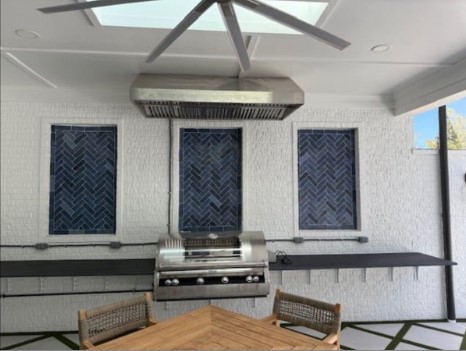
Kitchen ventilation plays an important role in managing smoke, steam, grease, heat, and cooking odours. For kitchens with cabinets positioned above the cooking surface, an under-cabinet range hood can provide ventilation without requiring a large standalone structure. The right hood should complement the kitchen layout while providing sufficient airflow for the cooking activities taking place underneath it. When considering stainless steel under-cabinet range hoods, homeowners should look beyond appearance and evaluate factors such as hood dimensions, CFM, ductwork, noise, filters, controls, and installation requirements.
Understand How Under-Cabinet Range Hoods Work
Under-cabinet range hoods are designed to fit beneath kitchen cabinets and directly above the cooking surface. Their compact configuration makes them useful for kitchens where wall space and cabinetry need to be preserved.
The hood draws smoke, steam, grease, and odours away from the cooking area through a fan. Depending on the model and kitchen configuration, the captured air may be exhausted outdoors through ductwork or filtered and recirculated back into the room.
Choose the Correct Hood Width
The width of the hood should correspond appropriately with the cooking surface. A hood that is too narrow may have difficulty capturing smoke and steam escaping from the sides of the range.
Under-cabinet hoods are available in different widths to accommodate various cooktops and ranges. Before purchasing, measure the cooking appliance and the cabinet space where the hood will be installed.
Consider Airflow Requirements
CFM, or cubic feet per minute, measures the volume of air a range hood can move. The appropriate airflow depends on the type of cooking, range size, fuel type, and heat output.
People who frequently fry, grill, sear, or cook with high heat may benefit from stronger ventilation than those who primarily prepare meals using lower temperatures.
For gas cooking, a commonly used guideline is at least 100 CFM for every 10,000 BTUs of cooking power. A 60,000-BTU range, for example, would require at least 600 CFM under this guideline.
Why Stainless Steel Is a Practical Choice
Material is another factor to consider when selecting a range hood. Stainless steel is widely used in kitchen appliances because it offers a clean appearance and can work well with different kitchen styles.
It can also be relatively easy to wipe clean when maintained regularly. This matters because range hoods are exposed to grease, steam, and airborne cooking particles during everyday use.
The appearance of stainless steel under-cabinet range hoods can also complement stainless steel appliances, creating a consistent visual style across the kitchen.
Check the Ductwork Requirements
Ductwork can have a major effect on ventilation performance. Even a hood with a powerful motor may not perform as expected if air has to travel through an unsuitable or poorly designed duct system.
The duct diameter should be compatible with the hood’s requirements. Long duct runs, excessive bends, and undersized ducts can create additional resistance and reduce effective airflow.
Think About Noise Levels
The sound produced by a range hood can influence how comfortable the kitchen feels during everyday use. Higher fan speeds generally produce more noise, particularly with high-CFM ventilation systems.
Multiple fan speeds allow homeowners to select the appropriate setting for different cooking tasks. A lower setting may be sufficient when simmering, while a higher setting can be useful when frying or preparing foods that generate significant smoke.
Pay Attention to Filter Design
Filters help capture grease and other particles before they enter the ventilation system. Regular cleaning is therefore an important part of range hood maintenance.
Baffle filters are commonly found in professional-style ventilation systems and are designed to handle grease effectively. Depending on the model, filters may be removable and dishwasher-safe.
Conclusion
Choosing an under-cabinet range hood involves balancing ventilation performance, dimensions, material, ductwork, noise, filtration, controls, installation, and maintenance. Stainless steel can provide a practical and versatile finish while fitting naturally into many contemporary kitchen designs. For homeowners researching stainless steel range hoods for your dream kitchen, comparing construction quality, airflow capacity, installation requirements, and maintenance features can help narrow down suitable options. A carefully selected and properly installed hood can provide effective ventilation while making the cooking area more comfortable, functional, and visually cohesive.